
Stories without words, finally reading Tintin, and steampunk mice
Inspiration time

Hello! Hope you’re OK.
November is almost done, and time has flown. Progress on the new King Rex adventure continues, with more pages pencilled in and ready to ink.
I’m trying to keep a routine of working on the new book before I go to (highly enjoyable) work (which I love). Drawing cues me up nicely for the day ahead, letting me get my mind warmed up, occupied and focused on the positive (I still look at the news more than I should in the morning, but I’m trying to reduce that - it’s rarely edifying or sets me up properly for the day). I’m a night owl by nature, but find that by the time work is done, the best of my creative energy is spent, so this golden 45 mins or so of uninterrupted creative morning time is vital.
Often I wish I could just keep going, but that’s the joy of a creative project that you don’t depend on for an income. It frees you up to create without expectations, pressure or dialling your instincts down for popularity’s sake. And I think that shows in the final result - the story comes first and has time to develop. I prefer this route - I think it would suck the joy out of my creativity if I had to treat it as a paid freelance for hire job.
I recently scrolled through the King Rex Book 2 pages so far on the computer, and had the satisfying thrill of seeing inked pages in reading order. I’ve inked up to page 30, with pencils up to page 39. (Book 1 was around 30 pages, with far fewer images per page). Can’t wait to get the second half of the book inked, as the story barrels to higher stakes and major tests for all the main characters!
Storytelling in the time you have
I watched an artist interview recently which I thought was fascinating. Matt Rhodes is a visual artist for video games, developing worlds and characters. For a few nights every week in between family life and work, he committed to drawing one page a week of a story he’d plotted out. It took him a few years, but he eventually ended up with a 360 page or so book which you can read here: https://www.mattrhodesart.com/tellurion
A few things stuck out to me from his conversation:
He was able to create more freely in some senses because he was creating in his own time. There’s always limits on time, but figuring out what you can realistically achieve within that, step by step, is necessary. But beyond that, there’s fewer limits or demands from external factors.
He played to his strengths. Realising he wasn’t confident as a writer, his story is told only through images. Every page is an image, and is designed to tell the story at several levels - it asks questions of the audience, teases meaning - getting several pieces of information across simultaneously.
What’s not shown is just as important as what is shown: it’s important to invite the reader’s imagination into the story to piece together what’s been left unsaid, hinted at, and picture in their own minds what happens beyond the timescale or scope of the page.
Know the ending of your story before you begin. This lets you seed things in the very first image that will be revisited, echoed, or pay off later. This is very satisfying to the reader.
How knowing the key theme of the story - the core thing you’re trying to say - makes a lot of subsequent decisions for you, about the world you’re creating.
The simplicity of his life in order to achieve creating a book, and setting realistic and achievable goals - in his case finishing one page a week at least. Not cramming your schedule with too many competing demands. He values his family, he goes to work, he makes things.
Just creating for 5 minutes when you don’t feel like doing anything. This soon snowballs and you make more progress than you thought you would.
Comics are not like film storyboards: time depicted in an image can vary, unlike in film. Also, the hierarchy often placed on film as a higher art form, above comics (Why? Many films have a committee voice rather than an authorial one; there’s brilliance and … not brilliance in both art forms).
The feedback loop created when he shared finished pages weekly, providing insight into what resonated with people, and a positive reward (finished work people can see) at a short timescale, which built momentum.
His work is amazing, and I’m hoping to pick up his art book one day. If you’re interested in telling your own visual stories, and the thinking and decisions which go into creating one, or be inspired in your own creative projects, the full interview is well worth a listen.
Reading Tintin
I’ve never been able to get into Tintin before (I’m an Asterix fan, sorry!), but as an appreciator of Euro comics, I felt the need to give Tintin another go. I asked for some of the books for my birthday, and have been really enjoying them.
The clarity of the line art, simplicity of the page layouts - everything serves to tell the story as efficiently as possible. I don’t recall seeing any lengthy text panel descriptions to ‘help the art along’; it’s predominantly all in the visuals and dialogue.
If you’ve never read Tintin before, I recommend starting from Cigars of the Pharaoh as you’ll get past the early days of the first three volumes. Apparently, Herge and his studio revisited the earlier books to redraw them in the later style: a master artist revisiting his earlier work to improve them. This is evident in Cigars of the Pharaoh as Tintin is in his widely recognised, finally developed style, but strangely the next book The Blue Lotus has Tintin and Snowy in Herge’s earlier style.
One of my favourite frames so far is from The Blue Lotus:
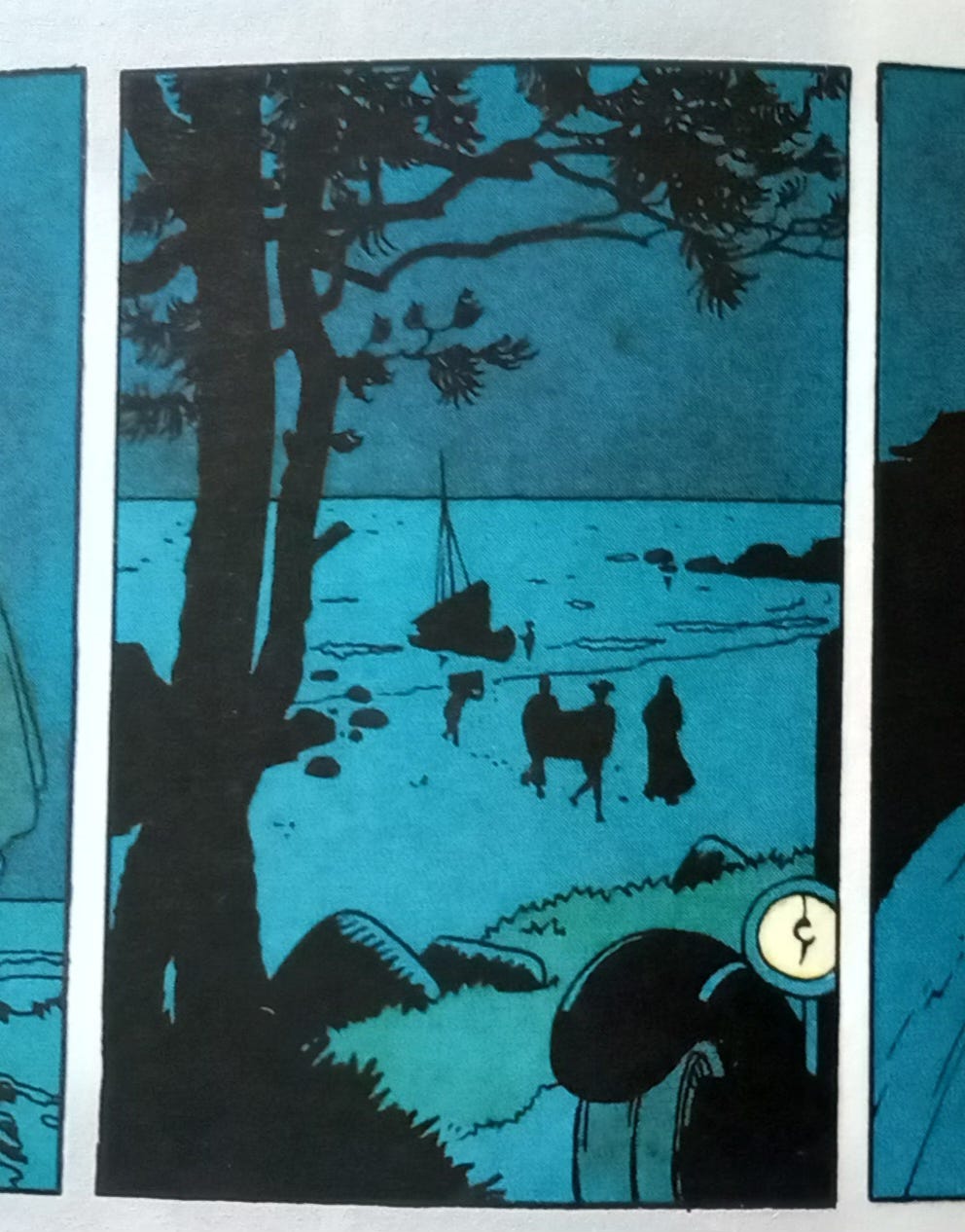
Thinking again about the portrayal of varying lengths of time in a single comics panel, this is a highly efficient storytelling image. The preceding page shows Tintin and Snowy being kidnapped, some boxes being left in the sea by a coast, and a box being unloaded from a small boat. This image tells us that the box is being carried by several people to their waiting car. You don’t see the mysterious figures pick it up, carry it to the car, or put it in the car - but you know it’s happened through that snapshot in time. And the context makes it likely it’s the kidnapped heroes who are being transported, but we’re still not 100% sure of what’s going on. And the action is in silhouette at night, adding to the shady nature of the event, the mystery and suspense. All this in a very small image. There are plenty more detailed, colourful, characterful and larger images in the book, but I was just struck by its efficiency and effectiveness. Masterful storytelling.
I’m looking forward to reading the rest of the books. Really looking forward to reaching Destination Moon, because SPACE and the giant iconic space rocket!
Steampunk Mickey
A while ago I’d added a French steampunk fantasy comic album to my Amazon wish list (as you do), and finding it again recently found this in the recommendations:
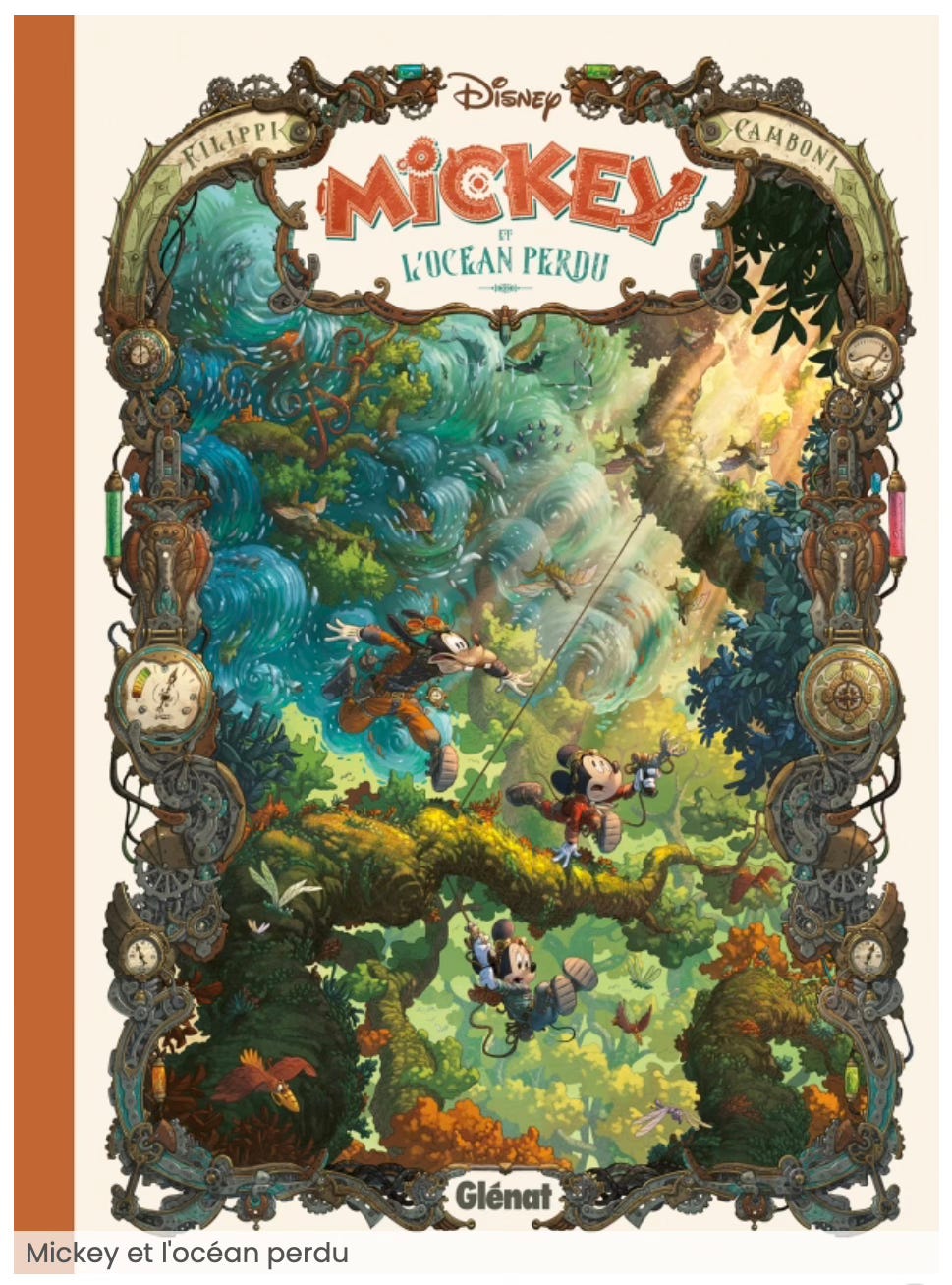
WHAAAT
I’ve never seen Mickey Mouse like this before. The artwork is stunning and the painting is gorgeous. This then lead me to:
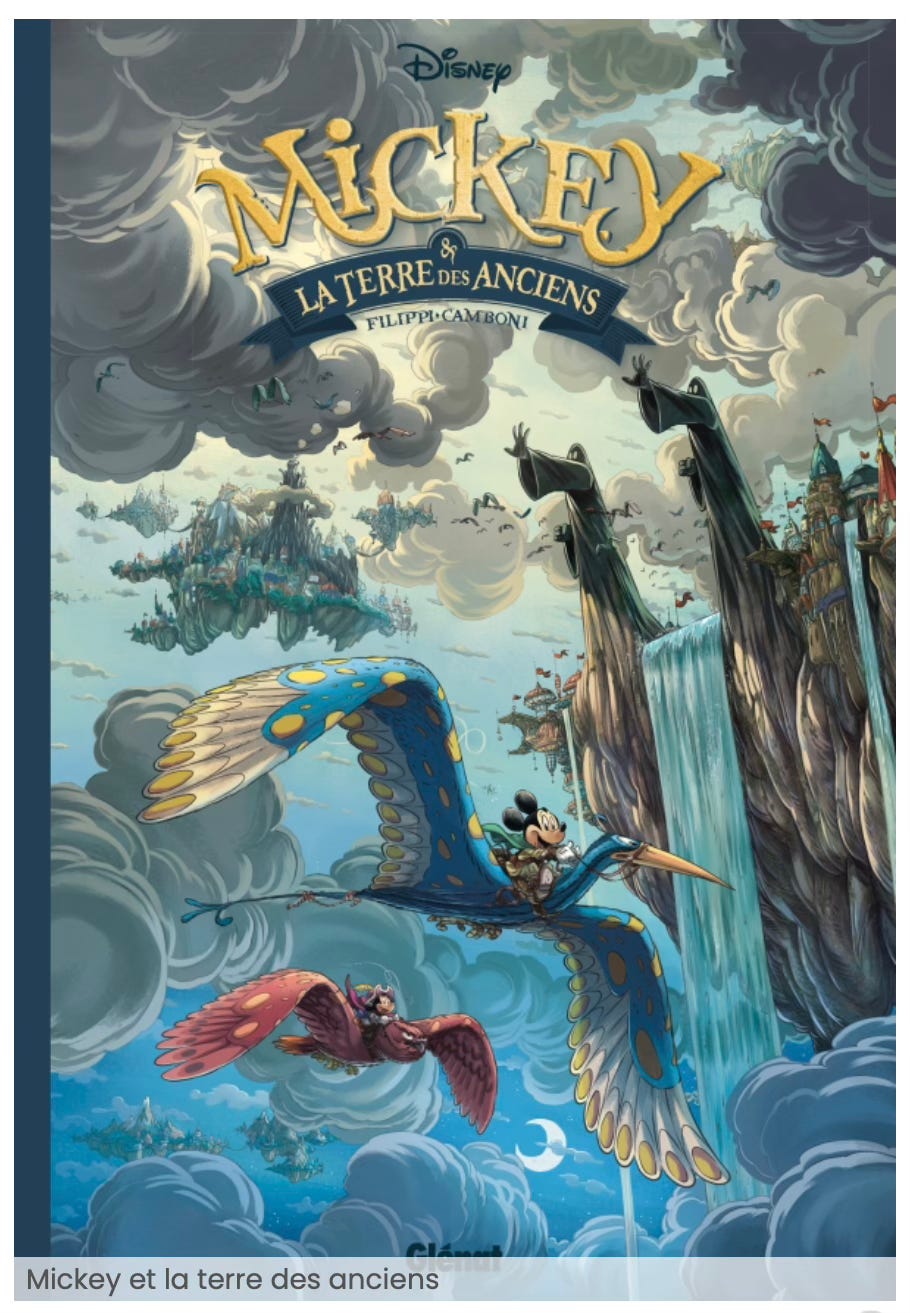
WHAAAAAAAT
Mickey Mouse in a steampunk fantasy adventure! I’m in. I’ll be ordering one of these very soon and letting my eyes bathe in its glory. Anthropomorphic animals on a thrilling adventure? Just up my street. Magic combo!
This is what comics can get so right. Disney, if anyone from the animated feature division should ever read this, I implore you to make one of these into an animated movie. What a way to bring Mickey into life for a new audience, bring him to the forefront of animation again, and tell a rollicking good story while doing it.
That’s it for now. Until next time!
Mr Cox, you hadn't read Tin Tin, my mind is blown. I love Tim Tin the stories are such engaging advertires and not too long, my only criticism he is annoying lucky.